In 1835, while digging a duck-pond in his garden in Margate, Kent, England, a man named James Newlove chanced upon something extraordinary: the blade of his shovel broke through into an underground cavity.
He and his son lowered a lantern down and entered what proved to be a winding subterranean passageway entirely lined with seashells. This stunning site is now known as the Shell Grotto.
A Passage of Shells: The Details
The passage itself is modest in size — around 70 metres (or roughly 230 feet) of winding chalk-cut tunnel, ending in a rectangular chamber (“the altar chamber”). According to official sources, the mosaic covers approximately 2000 sq ft and uses about 4.6 million shells including mussels, cockles, whelks, scallops and oysters.
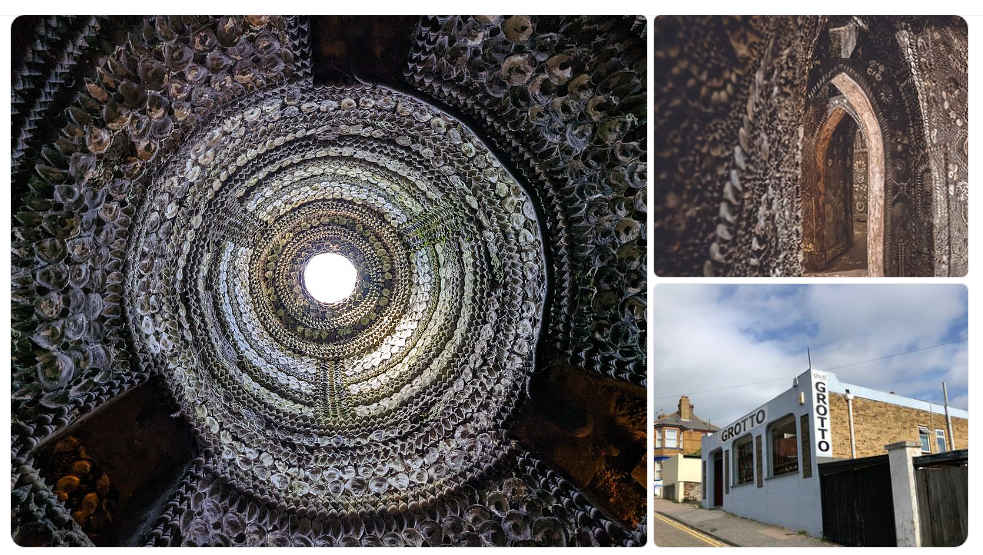
The shells are arranged in intricate geometric and floral patterns — stars, suns, spirals, arcs — so finely organized that their origin and purpose remain a mystery to this day.
Mystery at Its Core: Who Built It and Why?
Despite nearly two centuries of interest, the creator, date and purpose of the shell tunnel remain unknown. Some key facts:
- The earliest documented “discovery” is placed around 1835-1838.
- No carbon-dating has given a reliable date for the structure; attempts have been hampered by earlier gas-lighting soot, later repairs, and the difficulty of sampling without harming the site.
- Theories range widely: it might be a Victorian-era folly (ornamental underground art), an ancient pagan temple, a secret meeting place for a society such as the Knights Templar or a freemasonic group, or perhaps something far older—some scholars suggest the shells may even date to Phoenician or pre-Roman periods.
Why the Confusion?
Several factors feed into the enduring mystery:
- The site is privately owned, and large-scale invasive scientific testing (such as sampling for radiocarbon dating) has been resisted on the basis of preservation concerns.
- The building style is unusual: a winding chalk tunnel carved underground, combined with highly detailed shell mosaics is not a common pattern in British architecture.
- The shell materials themselves are mostly local, but some are not easily sourced nearby, raising questions about logistics and intention.
- Because shell materials themselves present challenges for carbon dating (mollusc shell radiocarbon ages can be misleading) the usual scientific route is problematic.
The Visitor Experience Today
Today, visitors to Margate can descend into the Shell Grotto, walking through the dimly-lit tunnel, peering into the altar chamber, and tracing the patterns made of millions of shells. The site is Grade I listed, meaning of significant historic interest.
Conservation work continues: earlier gas lamps had blackened many of the shells and water ingress has been a problem.
Why This Discovery Fascinates
- Unexpected origin: a garden pond-digging man in 1835 finds a subterranean shell-lined passage.
- Art and mystery blended: a work with no known creator, yet of dazzling craftsmanship.
- Deep time and lost purpose: could this be an 18th-century folly — or something much older?
- Puzzle with no final answer: the inability so far to date it conclusively adds to its allure.
- Aesthetic wonder: while the story intrigues, the visual impact of the shell mosaics stands on its own.
The Shell Grotto of Margate remains one of Britain’s most beguiling hidden wonders — a labyrinth of shells, light, shadow and unanswered questions. Whether built as a whimsical folly, a secret sacred space, or a monument to some long-forgotten ritual or artisan project, it invites the visitor — and the researcher — into a realm where craftsmanship meets mystery. The next time a spade meets the earth, who knows what lies dormant, waiting to be revealed?
A man in 1835 was digging a duck pond and accidentally uncovered a 104-foot tunnel made entirely of seashells…
James Newlove was digging a pond in his garden in Margate, England 🏴🇬🇧, when his shovel struck something unexpected—an opening that led to a long, winding… pic.twitter.com/QuOk7c537b
— Archaeo – Histories (@archeohistories) November 4, 2025
