The Nuragic civilisation flourished on the island of Sardinia (Italy) from roughly the 18th century BC through to its gradual absorption under Roman rule around 238 BC (and in some places even later).
Its name comes from the distinctive stone tower-fortresses known as nuraghi that dot the Sardinian landscape: over 7,000 are estimated.
The Nuragic society was complex and rich in ritual: they built villages, forts, sanctuaries, water-temples and sacred wells. Their mysterious religious practices, elaborate stone architecture and absence of a fully preserved written language add to their fascination. Over time their power waned as Punic and then Roman influence spread, and by the Iron Age the culture had largely transformed or been absorbed by new influences.
The Sacred Well: Pozzo sacro di Santa Cristina
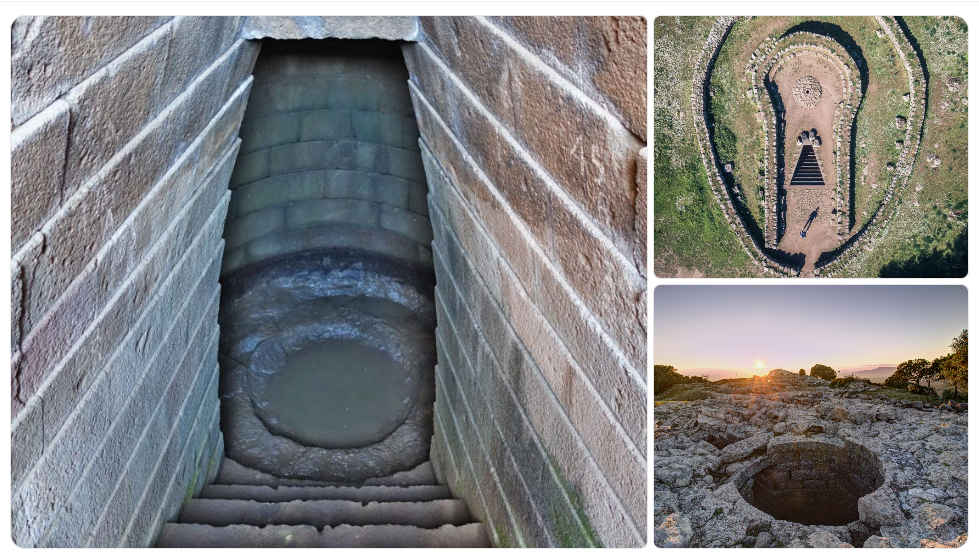
Perhaps the most visually striking and technically refined example of Nuragic sacred architecture is the so-called “well-temple” of Santa Cristina near Paulilatino in central-western Sardinia.
Built around the 11th century BC (Late Bronze Age) by the Nuragic culture, the structure features a trapezoidal vestibule, a narrowing staircase of about 25 steps descending to a circular chamber covered by a tholos vault, leading to the sacred water source.
What elevates this site beyond mere ritual water collection is its remarkable astronomical alignment: during equinoxes the midday sun penetrates the stairway to light the water below, and every ~18.5 years the moon’s maximum declination causes its light to reflect in the pool at the bottom of the well through a small oculus.
These features suggest the Nuragic builders deliberately combined water cults with celestial observation—linking earth, water, and sky in a sacred architecture. The entire setting, with its smooth basalt blocks and stairway descending into a subterranean chamber, has a fantasy-like quality—indeed the tweet’s comparison to a scene from the legends of modern video-games is not entirely misplaced.
This well is more than a beautiful ruin; it is a window into the Nuragic worldview. It shows a society that:
- valued water as a sacred element (springs and wells were ritual focal points).
Wikipedia - invested in precision stone architecture and engineering.
- had keen interest in astronomical phenomena and cycles (sun, moon, water) and tied them into ritual time-keeping and possibly community gatherings.
Studying these sites helps us understand Sardinia’s Bronze-Age societies in ways that standard village archaeology alone might miss: they show ritual landscape, astronomical sophistication, and a deep relationship between community, nature and the cosmos.
This precision-fit megalithic well was built by the Nuragjc civilization and features a lunar alignment. It is the Pozzo Santa Cristini and it looks like something straight out of the legend of Zelda if I’m being honest pic.twitter.com/yhqkxLfBCr
— Archaic Lens (@ArchaicLens) October 20, 2025
